

How Ambient AI Scribes Are Transforming Medical Documentation and HIPAA Compliance
Discover how Ambient AI Scribes are revolutionizing healthcare documentation, offering significant benefits and essential preparation steps for seamless integration at your clinic.
Originally published May 20, 2025. Updated on April 09, 2026.
What are Ambient AI Scribes?
Ambient artificial intelligence (AI) scribes are becoming a standard part of digital healthcare workflows for clinicians. These AI tools are designed to listen during patient encounters (in-person or virtual), automatically capture comprehensive clinical notes, and summarize them into the electronic health record (EHR) format.
Some ambient AI scribes work in real-time, transcribing and organizing information as the conversation unfolds. Others pull audio recordings and transcribe key details afterward. In both cases, clinicians review the notes and make adjustments before adding the documentation to the patient’s health record.
All ambient AI scribes utilize automated speech recognition and large language models (LLMs) to convert audio into text. They are trained in medical knowledge, enabling them to recognize nuances in speech patterns and medical terminology. This includes the crucial ability to distinguish between a “murmur of reassurance” and a “cardiac murmur.”
The Benefits of Ambient Medical Scribes for Healthcare Providers
Ambient AI scribes stand out for their ability to enhance both the patient-provider relationship and the quality of documentation. By decreasing the documentation workload during and after clinic hours, they help clinicians spend more time focused on patient care, ultimately supporting well-being and reducing professional stress.
The report from the Peterson Health Technology Institute (PHTI), titled “Adoption of Artificial Intelligence in Healthcare Delivery Systems: Early Applications and Impacts,” highlights that for every hour a clinician spends with a patient, they spend an additional two hours on documentation in the EHR. Furthermore, one in five clinicians report spending eight or more extra hours per week working in the EHR.
The PHTI report also noted that patient interaction improved when clinicians used ambient AI scribes during appointments. Relying on the AI scribe for transcription notes allowed clinicians to engage directly; they could spend more time making eye contact, actively listening, and participating in meaningful conversations with patients, rather than focusing on a computer screen.
As a result, ambient AI scribes are becoming an increasingly attractive solution for healthcare organizations looking to balance high-quality patient care with the demands of clinician administrative responsibilities.
Ambient AI scribes offer the following benefits:
- Time saved
- Reduced administrative overload
- Improved accuracy of patient encounter notes
- Enhanced patient-provider interactions
How Ambient AI Scribes Impact Patient Data Privacy and HIPAA Security
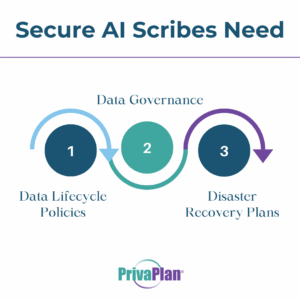
While an AI scribe can elevate the clinician’s experience, it must also balance the crucial need for data privacy to ensure regulatory compliance and maintain patient trust.
Integrating an AI scribe into clinic workflows requires configuring security settings to comply with the HIPAA Security Rule and ensure that electronically protected health information (ePHI) remains private.
Security elements include items such as:
- Access controls
- Transmission and encryption security
- Data governance policies and procedures
- Data integrity and management
- Logging, monitoring, and incident reporting
When selecting a medical scribe solution to integrate into your clinic’s workflow, it’s essential to develop comprehensive policies and procedures for data management. This includes clearly defined methods for collecting data and what types of information will be gathered during the clinical process.
By prioritizing these elements, you can ensure that your ambient AI scribe solution supports not only efficiency in clinical workflows but also the integrity and security of patient information.
Business Associate Agreements for Ambient AI Scribes
Before employing ambient medical scribes, you will want to review a few key points to build a compliance framework that aligns with your current HIPAA compliance efforts. This includes examining how you will obtain informed consent from patients, reviewing state privacy laws, and determining the data safeguards that you expect the vendor to uphold.
It’s best to review your organization’s security risk, data governance policies, access controls, retention policies, and incident response plans before utilizing the tool. These factors inform the details of the business associate agreement you will sign with the ambient medical scribe vendor.
The most critical compliance step is the Business Associate Agreement (BAA) with your vendor. Under HIPAA, a business associate is any third-party vendor who creates, receives, maintains, or transmits protected health information (PHI) on behalf of a covered entity.
Ambient AI scribe vendors are business associates because their technology directly handles PHI by listening to patient encounters, processing clinical conversations, and generating documentation for the electronic health record system. You need a comprehensive and signed BAA in place before using ambient scribes for patient encounters.
When reviewing or negotiating your BAA, make sure it addresses:
- How the vendor collects, stores, and deletes ePHI.
- Who on the vendor side has access to audio recordings and transcriptions?
- How the vendor will handle a data breach.
- What is the vendor’s notification timeline in the event of a breach?
- Whether the data is used to train the vendor’s AI models, and if so, whether your patient data is included.
- What happens to your ePHI if you terminate the contract?
- What data-deletion methods will the vendor use when you either close an account or terminate a contract, especially for ePHI?
Consent Requirements for Ambient AI Scribes
Your Notice of Privacy Practices was written before ambient AI existed. If it has not been updated, it may not cover what the ambient scribe is doing.
The NPP describes how your healthcare organization uses and discloses PHI. When an ambient AI scribe is added to the workflow, a new data flow is created between audio recordings, transcriptions, and clinical notes processed by a third-party vendor.
As mentioned above, the vendor is now acting as a business associate because they are creating, receiving, maintaining, and transcribing PHI on behalf of the covered entity. This means the data flow falls under HIPAA, and you, as the covered entity, need to ensure this workflow is outlined in your NPP.
Review your current NPP and update it to describe the use of AI-assisted documentation, the data it captures, and the protections in place. If your NPP does not mention it, you are already behind.
Your organization also needs to consider what consent practices your healthcare team will use with patients. Consent processes that are transparent, flexible, and inclusive are the best way forward. Remember to check your state’s privacy laws. Many states regulate the recording of private conversations, with some requiring the consent of all parties. You may want to meet with legal counsel to discuss visit-level disclosures and establish a required consent process.
Learn more about the Notice of Privacy Practices in our recent article.
Your Clinic Is Still Responsible for HIPAA Security Rule Compliance while using an Ambient Medical Scribe
To successfully implement an effective AI medical scribe workflow process, you must understand the clinical and administrative workflows across the entire organization. This includes examining the data governance, metadata, documentation practices, and how different departments communicate and collaborate.
By gaining this insight, you can tailor the AI medical scribe system to seamlessly integrate into existing processes, enhance efficiency, and improve the overall inputs and outcomes of the transcriptions.
But getting started with integrating an AI tool while maintaining HIPAA compliance can be confusing. That’s where our new guide comes in!
Prepare Your Clinic for a Seamless AI Ambient Scribe Integration with PrivaPlan’s Essential Guide
Our Third-Party Generative AI in Healthcare: Balancing Innovation with the HIPAA Security Rule guide draws on our 20 years of HIPAA compliance expertise to help healthcare organizations confidently adopt generative AI solutions while proactively protecting the confidentiality, integrity, and availability of sensitive health data.
This practical guide bridges the gap between HIPAA and AI by providing frameworks and actionable strategies for implementing AI tools that align with the HIPAA Security Rule and the National Institute of Standards and Technology (NIST) framework.
The guide includes how to:
- Map out AI governance.
- Configure concentrated HIPAA-focused security settings.
- Establish clear policies for input and output.
- Ensure data privacy
- Provide training and support for your workforce.
Take the first step toward optimizing your clinic’s workflow and safeguarding patient data. Secure your copy of our essential guide today and lead your organization into the future of HIPAA-compliant AI integration.
Don’t miss out on the chance to improve your health clinic workflow and grab your copy today!
Frequently Asked Questions About Ambient AI Scribes
Q: How widely adopted are ambient AI scribes in 2026?
Ambient AI scribes have moved beyond pilot programs and are quickly becoming the standard for clinical documentation. About one-third of providers now have access, and experts predict most will adopt the technology by year-end.
Q: Are major EHR platforms integrating ambient AI scribes natively?
Increasingly, yes. Nearly two-thirds of hospitals using Epic Systems have adopted ambient AI tools, as Epic has made its AI-powered charting functionality broadly available to its EHR clients. Additionally, Athenahealth began offering its ambient AI scribe free to all customers in February 2026, removing cost barriers for hundreds of thousands of providers.
Q: What are the key HIPAA compliance risks when deploying an ambient AI scribe?
Deploying an ambient scribe often requires updating your organization’s security risk analysis, access controls, retention policies, and incident response plans. Unlike static software, ambient scribe systems use dynamic models that may be updated or retrained over time, sometimes with limited transparency. This raises governance challenges around oversight, explainability, and accountability.
Q: Do I need to include our Ambient AI Scribe in the HIPAA Security Risk Analysis?
The HIPAA Security Rule is clear: any technology that touches electronic protected health information (ePHI) must be evaluated, protected, and accounted for. While HHS has yet to issue specific guidance on how generative AI tools like ambient scribes fit within the HIPAA Security Rule framework, the principle is straightforward: if it processes ePHI, it belongs in your security risk analysis. And ambient AI scribes absolutely process ePHI.
Including your ambient scribe in your annual security risk analysis means you’re doing exactly what the Security Rule requires: identifying vulnerabilities, assessing threats, and implementing the right safeguards to protect patient data. It also means you can clearly demonstrate that your organization is adopting new technology responsibly.
Q: Is patient consent required before using an AI ambient scribe?
There are two driving factors in considering this question. The first is state laws. Many states regulate the recording of private conversations, and some states may require consent from all parties before a recording can be made. Ambient AI scribes were designed as a recording and transcription service, which means you must know what your state’s laws are before using this in a clinical/patient encounter. When in doubt, follow consistent standards and gain consent before recording.
The second factor is transparency. Clearly inform patients that their healthcare visit will be recorded, explain privacy and security protections for their PHI, and outline their right to opt out. These steps are best practices for keeping patients informed.