Privacy Rule Update: Major Changes Explained
The long-awaited Health Insurance Portability and Accountability Act (HIPAA) Privacy Rule update was released on November 16, 2026, by the Department of Health and Human Services (HHS) Office for Civil Rights (OCR).
Changes to the Privacy Rule were initially introduced in a 2020 Proposed Rulemaking and focused on updating administrative barriers and encouraging health data sharing between providers. Modifications to the rule also include strengthening individuals’ rights to access their protected health information (PHI) and providing better care coordination for patients.
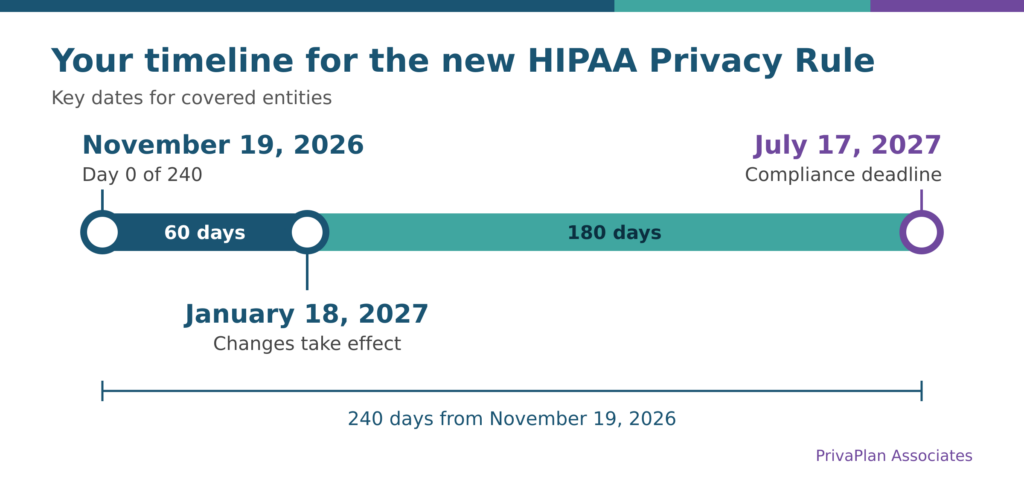
Titled HIPAA Privacy Rule: Changes to Support Coordinated Care and Individual Engagement and Reduce Regulatory Burdens, the final rule takes effect 60 days after federal registration, which is scheduled for November 19, 2026. The good news for covered entities and business associates is that compliance is required 240 days after publication, landing on July 17, 2027. This gives you and your healthcare team roughly eight months to prepare.
Preparing for the required compliance changes means understanding what is expected. Our article covers the changes that matter, what they mean for your team, and how PrivaPlan is updating our resources to support you.
The HIPAA Privacy Rule became law in 2003 and requires covered entities and business associates to safeguard patient privacy and health information, including how providers can use and disclose PHI. The foundation of the Privacy Rule has always been based on a patient’s rights, including the right to access their medical records, to amend PHI, to have an accounting of disclosures, and to receive a Notice of Privacy Practices (NPP).
These Privacy Rule changes continue to benefit patient access to their PHI and now clarify that sharing PHI is allowable with social service and community organizations that assist with patient care coordination. While some administrative burden is removed, HIPAA covered entities will need to modify their written NPP revise policies and procedures, and provide workforce training.
The Right to Understand and Discuss Your Notice of Privacy Practices
What Changes: Part of the administrative burden that the update eliminates is the requirement that covered entities obtain a patient’s written acknowledgment that they received the NPP. HHS currently says that making a good-faith effort to get a signed acknowledgment of NPP receipt, or documenting those efforts, costs providers time and effort.
While this is welcome news for front desk and registration teams, the intake workflow still requires a knowledgeable workforce member to be available to answer patient questions about the NPP. Instead of a written acknowledgment, patients now have the right to discuss the NPP with a designated contact, either in person or with scheduled calls or meetings.
Other changes to the NPP are also required, including providing patients with information for:
- How to access health information
- How to file a HIPAA complaint
- Updates to the right-of-access language
How to Prepare for the 2027 NPP Changes:
- Revise your organization’s NPP to match the new requirements before July 2027. HHS has announced that they will update their model NPP notice sometime next year.
PrivaPlan offers easy-to-use NPP templates in our Toolkit, designed to save you time and effort. Even better, these templates will be refreshed in 2027 to include all the latest Privacy Rule changes.
- Retire the acknowledgment process. Providers with a direct treatment relationship no longer need to make a good-faith effort to collect a signed acknowledgment of NPP receipt, or document that effort. Update intake workflows, forms, and staff scripts to match.
- Update the NPP header. The header must now say the notice covers how to access health information, how to file a HIPAA complaint, and individual rights. Those rights include getting a copy of the notice and discussing it with a designated person or office. Use “health information” in place of “medical information.”
- Add the right to discuss to your NPP. The NPP must tell individuals they can talk through it with a person or office you designate. Onsite staff, scheduled calls, or a triage tool are sufficient provisions, as long as the individual can reach someone knowledgeable.
- Assign designated contacts: This person should know your privacy practices and complaint process and be able to train other members of your workforce. While assigning a HIPAA Privacy Officer to this role is logical, consider also designating a front desk team member who interacts with patients more frequently. Remember the contact person won’t provide general customer service; they will be a knowledge base for any questions about your organization’s policies outlined in your NPP.
- Retire the Correctional settings: The inmate exception is gone. Providers serving correctional institutions should give the NPP in person at the first health care encounter. Limits on inmates’ right of access for safety and security reasons stay in place.
- Train your workforce, especially your front desk and registration staff, on how to route questions about the notice to your designated contact.
- Post the revised NPP online. Covered entities that maintain a website must post the updated NPP there.
The Right to Access PHI Within 15 Calendar Days
What Changes: The deadline for responding to an access request drops from 30 days to as soon as practicable, and no more than 15 calendar days after receipt.
One extension of up to 30 calendar days remains available, but only if you notify the individual in writing within the first 15 days, with the reasons for the delay and the date access will be provided.
Patients can now direct a covered entity to send an electronic copy of their PHI to a person they designate.
How to Prepare:
- Assign an owner and a backup for access requests and log the date when every request arrives.
- Review your request form and the workflow of verification steps to determine the steps for access and how long each step will take. You may want to build a time tracker to help with the request process.
- Map where records live, including records held by business associates, so retrieval is quick.
- Create an extension notice template that explains the reason for the delay and the new access date, so it can be sent within the first 15 days.
The Right to Know What Access Costs
What Changes: Free Access
Covered entities may not charge for in-person inspection of PHI.
They may not charge for viewing or obtaining electronic PHI through an internet-based method, when the requested form and format are available that way. Examples include a patient portal’s “View, Download, and Transmit” function, or a personal health app connected through a secure, standards-based API.
Requests that need staff labor, such as emailing a PDF that staff prepared, are not free.
What Changes: Permissible Fees
- Fees must be reasonable and cost based.
- Covered entities may charge only for:
- labor to copy PHI
- supplies for non-electronic copies
- postage for mailed non-electronic copies
- preparing a summary or explanation the individual agreed to
- Covered entities may not charge for searching, retrieving, reviewing, verifying, or maintaining systems. They also may not charge for electronic media or electronic postage.
- State laws that give individuals greater access rights or lower fees still apply.
What Changes: Fee Schedule Posting
- Covered entities with a website must post their fee schedule there. They must also make it available at the point of service and on request.
- The schedule must:
- identify all free forms of access
- list standard fees for right of access copies, copies sent to designated persons, and authorization disclosures
- explain how the labor, supply, postage, and summary charges add up to the total
- Labor may be listed as an hourly rate.
- Average costs are recommended but not required.
How to Prepare:
- List every way individuals get records from you today and mark which ones are free under the rule.
- Calculate your labor, supply, and postage costs using only the chargeable categories.
- Review your state’s access and fee laws, then incorporate this information into your calculations.
- Draft the schedule and have your HIPAA Privacy Officer and finance lead review together.
- Choose a clear place for it on your website and keep copies at registration and ready to hand over on request. Posting puts your fees in the open, so the schedule needs to be accurate, easy to find, and consistent with what your team charges.
- Align your billing system with the schedule and brief the people who answer fee questions.
Care Coordination Disclosures
What changes: Covered entities can now share PHI without authorization with social services agencies, community-based organizations, home and community-based services providers, and similar third parties that serve specific individuals.
- Scope: This covers individual-level care coordination and case management that counts as treatment or health care operations. Population-based activities are not included.
- Minimum necessary: The usual minimum necessary rules still apply.
- No extra steps: Beyond what the NPP already says, no consent, authorization, advance notice, or opt-out is needed.
- Individual rights: Individuals can still request restrictions.
- Not covered: Disclosures to law enforcement or child welfare agencies for investigative purposes.
How to Prepare:
- Identify the community partners your care teams already work with.
- Write a one-page procedure covering when a disclosure is appropriate, what the minimum necessary is, and who approves it.
- Confirm your NPP describes the treatment and health care operations uses and disclosures you make.
- Teach care teams how to receive and honor a request for restrictions.
- Update your policies and procedures to reflect these changes.
Business Associate Agreements
What Changes: Existing written agreements that complied with the HIPAA Rules before publication can continue for up to one year after the rule’s effective date. The extension ends earlier if the agreement is renewed or modified after the compliance date.
- Limited relief: The extension covers only the amendment requirement. Other obligations still apply, such as business associates responding to access requests within 15 calendar days.
How to Prepare:
- List the business associates that hold records you would need for an access request.
- Confirm each one can meet the 15-day window.
- Plan agreement amendments around your normal renewal cycle.
Two Smaller Updates
- Telecommunications Relay Services: Disclosures to communications assistants are expressly permitted. These providers are excluded from the business associate definition.
- Uniformed Services: The permission to disclose Armed Forces members’ PHI to command authorities for mission readiness now covers all Uniformed Services. That adds the U.S. Public Health Service Commissioned Corps and the NOAA Commissioned Corps.
Getting Ready for the New HIPAA Privacy Rule Before July 2027
July 17, 2027 may feel far away, and that works in your favor. The changes to access, fees, the NPP, and care coordination touch several parts of your organization at once, but none of them has to be rushed. Start by deciding who owns each area and mapping how the work actually gets done today. Then update your documents and workflows in the spring. Spend the final weeks training your team and testing the new process, so you walk into July with confidence. A steady pace also builds more than readiness. A clear access process and a plain-language NPP make it easier for patients to trust you and easier for partners to work with you.
Your Timeline:
Now through January 18, 2027: Lay the groundwork
- Assign an owner to each area of change.
- Map how each workflow runs today.
- Attend our webinars.
January through April: Update documents and workflows
- Revise your NPP.
- Rebuild the access process.
- Draft and post the fee schedule.
- Write the care coordination procedure.
May through July 17: Train, test, and go live
- Train your workforce on the updates and new procedures.
- Run a practice access request from start to finish.
- Confirm your fee schedule is posted and easy to find.
- Put the new NPP into use before the deadline.
Final Thoughts
Every change in this rule replaces ambiguity with a defined process: named owners, tracked deadlines, a posted fee schedule, and written procedures. Defined processes mean less rework and fewer exceptions, and your team spends its time on patients rather than on workarounds. Strong risk management is also a business advantage. It builds trust, and trust supports the top line.
PrivaPlan has been helping clients with HIPAA for 25 years, and we’re with you through this change too. We will be hosting webinars on the updates where you can ask questions, get practical guidance, and learn how other organizations are approaching these changes. Be sure to sign up for our newsletter to receive the latest webinar dates!